


Utilizes filament for precise, layer-by-layer deposition, delivering ease of use, fine detail, and broad compatibility with both desktop and professional 3D printers. Ideal for prototyping and producing small to medium-sized parts with high accuracy.
Uses pellets for direct material extrusion, enabling high-speed, large-scale production with reduced material waste. Ideal for industrial applications and complex geometries, especially for large components.
Fused Filament Fabrication (FFF), also known as Fused Deposition Modeling (FDM), is an additive manufacturing process that uses thermoplastic filament as its primary feedstock. This technology offers numerous advantages, particularly in prototyping, functional part development, and distributed manufacturing. In recent years, FFF has seen strong expansion across a wide range of industries and is commonly used for applications such as engineering prototypes, end-use components, and manufacturing aids including jigs and fixtures. The maturity, accessibility, and relatively low cost of the technology have enabled the deployment of large-scale printer farms, making FFF the fastest-growing thermoplastic additive manufacturing process. TAFNEX™ Filament enables the production of high-performance parts designed to perform reliably in diverse environments.
Fused Granular Fabrication (FGF) is an additive manufacturing technique that utilizes unreinforced or reinforced thermoplastic pellets as its primary material. This method provides numerous benefits, particularly in the realm of large-format additive manufacturing (LFAM). FGF is experiencing rapid growth across various industries and has become a leading technology for producing components such as boat hulls and molds for concrete or composite manufacturing. TAFNEX™ Compound, available in a specialized grade for FGF, unlocks vast potential for creating high-performance components suitable for diverse environments.

Pellets are the predominant form of plastic materials, widely utilized in processes like Injection Molding and extrusion. This prevalence ensures a vast availability of materials, far surpassing that of filaments used in fused filament fabrication (FFF).

Pellets are not only more readily available than filaments but also come at a lower cost, thanks to the absence of an additional production phase. They can also be ordered in larger quantities, which leads to a further reduction in costs.

With no requirement for molds and the ability to swiftly change materials, FGF delivers a high level of flexibility. The process involves no physical conversion effort – just a digital change of the component geometry.

FGF stands out among additive manufacturing processes by offering superior scalability for industrial production, thanks to its material availability and high-speed extrusion capabilities.

FGF supports sustainability with the possibility to utilize bio-based and recycled materials. For instance, it can employ compounds derived from recycling thermoplastic composites such as TAFNEX™.
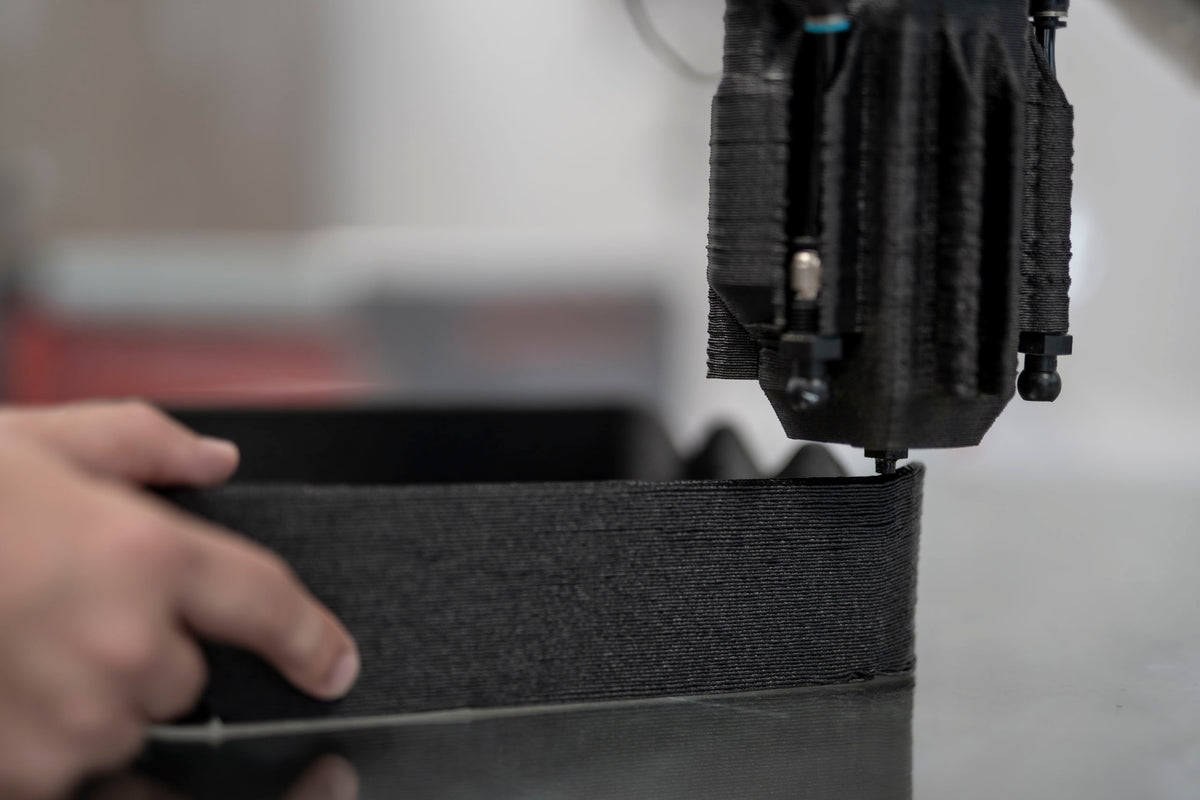
FGF is essentially a mobile version of conventional plastic extrusion, using a typical extruder mounted on a robot or gantry system. Dry pellets are fed into a hopper and moved by an extrusion screw through multiple heating zones, where they melt before being extruded. Controlled by pressure within the extruder, this process follows the contours defined by the software, applying material layer by layer along the component's geometry. The process, depending on the material, is conducted in a sealed, temperature-controlled chamber to ensure layer adhesion, and the printing bed is often temperature-regulated as well. Mechanical post-processing is typically required after FGF manufacturing to achieve smooth surfaces. Some manufacturers provide systems that integrate both additive manufacturing via FGF and subsequent subtractive processes in a single cell.

By using TAFNEX™ Pellets, hood air duct bezels of a safety car have been produced through Fused Granular Fabrication (FGF). A formed TAFNEX™ Design Sheet can be added for improved aesthetics.

By using TAFNEX™ Filament, a motorcycle rear fender has been produced through Fused Filament Fabrication (FFF).

By using TAFNEX™ Pellets, rear spoilers of a safety car have been produced through Fused Granular Fabrication (FGF).

By using TAFNEX™ Pellets, the fenders of a safety car have been produced through Fused Granular Fabrication (FGF) with the addition of formed a TAFNEX™ Design Sheet for improved aesthetics.